Why Timing Your Beach Workout Around Low Tide Changes Everything
Quick Answer: Training near low tide, on the firmer, packed sand closer to the waterline, delivers a more stable, joint-friendly surface than soft, dry high-tide sand, which shifts under every step and increases workout difficulty and fatigue significantly. Checking a local tide chart before planning a beach session makes a measurable difference in how the workout feels.
Anyone who has struggled through a beach workout that felt exhausting for no clear reason has likely just picked the wrong tide window without realizing it mattered.

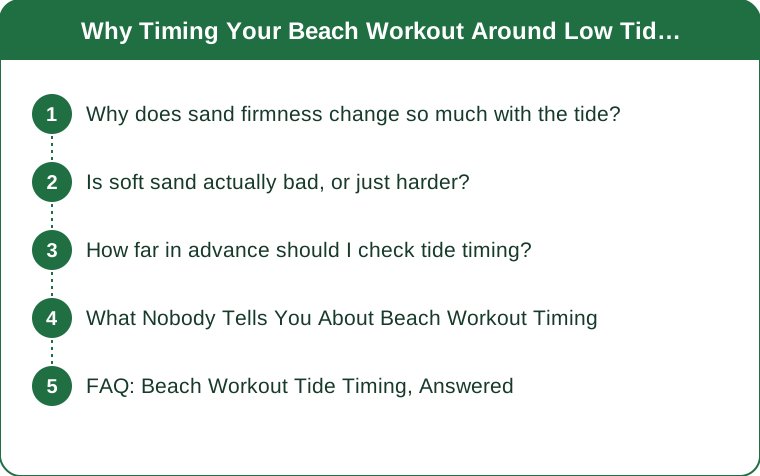
Why does sand firmness change so much with the tide?
As tide recedes, the sand near the waterline stays compacted and damp, creating a firmer, more stable surface, while sand further from the water dries out and becomes soft and shifting. This firmness difference is the single biggest variable in how hard a beach workout feels underfoot.
Is soft sand actually bad, or just harder?
Soft sand isn’t bad — it increases resistance and works stabilizer muscles harder, which can be a deliberate training goal for some sessions — but it also raises injury risk for ankles and calves if used for high-volume running rather than shorter, deliberate strength intervals. Matching the sand type to the workout goal matters more than avoiding soft sand entirely.

How far in advance should I check tide timing?
Checking a tide chart the night before, or using a tide app the morning of, is usually enough since tide timing shifts by roughly 50 minutes each day and is fully predictable in advance. Planning a run or cardio circuit within an hour or two of low tide gives the widest window of firm, packed sand.
What Nobody Tells You About Beach Workout Timing
Most people assume any beach is fine any time, but the width of firm sand exposed at low tide varies hugely by beach — some expose a wide, flat strip while others barely change. Scouting a specific beach’s tide behavior once, rather than assuming general tide rules apply evenly, saves a lot of frustrating short-firm-strip workouts later.
FAQ: Beach Workout Tide Timing, Answered
Does tide timing matter for strength training too, not just running?
Less critically, since strength circuits don’t require as much continuous stable footing, but firm sand still makes balance-based moves like lunges or single-leg work considerably easier to execute with good form.
What if low tide falls at an inconvenient time of day?
Mid-tide, an hour or two before or after the lowest point, still offers reasonably firm sand in most locations — it doesn’t have to be the exact low-tide minute.
Are there tide apps that make this easier to check?
Most weather apps now include a tide chart for coastal locations, and dedicated tide apps offer more precise, location-specific predictions worth checking for a regular beach workout routine.
TL;DR:
- Low tide exposes firmer, more compacted sand that’s noticeably easier to train on
- Soft, dry sand increases resistance and stabilizer work but raises injury risk at high volume
- Tide timing shifts about 50 minutes daily and is easy to check the night before
- Not all beaches expose the same amount of firm sand, so scouting your specific beach helps
A five-minute tide check can turn a frustrating beach workout into one of the best sessions of the week.
See It in Motion
Seen here: Racerback Tank Top - White — shop similar styles on bubblelime.com
Keep Reading
This article is for general informational and styling purposes only. Fit, sizing, and product availability may vary.