How to Use the Last Few Warm Beach Sessions of the Year
Quick Answer: The last warm weeks of the season are best spent on the things sand does better than a gym floor — single-leg stability, deceleration work, and low-impact conditioning — rather than on max strength or speed, which sand actively degrades. Three focused sessions beat six unfocused ones.
The water is still warm. The crowds have thinned. The light at 7pm is doing that thing.
You have maybe five or six usable weekends left, depending where you are.
So the question is not whether to train on the beach. It is what sand is actually good for.

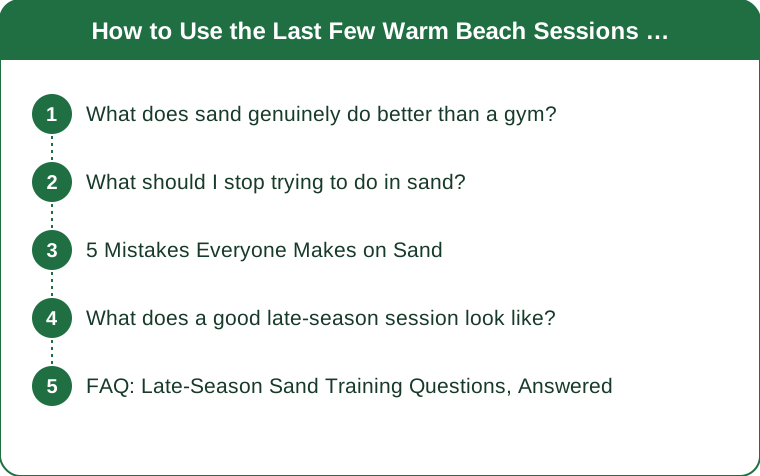
What does sand genuinely do better than a gym?
Three things, and they are worth naming precisely.
It punishes instability honestly. On a stable floor, a wobbly single-leg squat can be masked by a strong quad. On dry sand, the surface moves under you and the small stabilisers around the ankle and hip have to work continuously. That is not a gimmick — it is a real and hard-to-replicate demand.
It absorbs impact. Ground reaction forces in dry sand are meaningfully lower than on pavement, which makes it a genuinely useful surface for people returning from lower-limb niggles or carrying extra bodyweight.
It taxes conditioning at low speed. Sand running at a jogging pace can cost 40 to 50 percent more energy than the same pace on a track. You get a serious cardiovascular session without the joint bill.
Everything else sand does is a downgrade. Plan around these three.
What should I stop trying to do in sand?
Max sprints. Loose sand steals push-off. You cannot reach the speeds that make sprint training useful, and the unstable heel strike raises Achilles and calf strain risk considerably. If you want speed, do it on the firm strip near the waterline or not at all.
Heavy or loaded strength work. Any lift where a stable base matters — squats, presses, loaded carries — is compromised. You will use lighter loads and get less out of them.
Long slow distance without a plan. An hour of soft-sand jogging is a genuinely high load disguised as an easy session. Two people I know have pulled calves this way in September, both convinced they were doing something gentle.
Anything demanding on the first session back. Sand-specific soreness in the calves and feet is real and shows up 24 to 48 hours later. Your first session of the season should be half what you think you can handle.

5 Mistakes Everyone Makes on Sand
1. Training on a sloped beach in one direction only. Most beaches slope toward the water. Running out and back along the same line means one leg is chronically shorter through the whole session. Turn around every 3 to 4 minutes.
2. Going barefoot straight from a summer of trainers. Sand is the softest surface you will ever run on, but it is also the one that most exposes an unconditioned foot. Build up over three or four sessions.
3. Ignoring the tide chart. The firm wet strip that makes intervals possible exists for a window of a few hours. Turning up at the wrong time means a session in soft sand you did not plan for.
4. Skipping the calf warm-up. Sand loads the calf differently from step one. Two minutes of easy heel raises and ankle circles is not optional here.
5. Treating the last session of the season as the biggest. The third mistake surprises people, but this one costs the most: the urge to make the final beach workout memorable is precisely how late-September calf strains happen.
What does a good late-season session look like?
Forty minutes, three parts.
Warm-up, 8 minutes. Easy walk on the wet strip, ankle circles, 15 slow heel raises per side, 10 walking lunges, 4 short accelerations at maybe 70 percent.
Main block, 20 minutes. Alternate 90 seconds of soft-sand jogging with 90 seconds of a single-leg or lateral movement — split squats, lateral bounds landing under control, single-leg balance reaches. Six rounds. The alternation is deliberate: it lets the calves recover while the stability work continues.
Finisher, 6 minutes. Something you cannot do indoors. Bear crawls in soft sand for 20 metres, walk back, four rounds. Or hill work up the dune line if there is one.
Cool-down, 6 minutes. Walk on the firm strip, then get in the water if it is still warm enough. The cold water does more for next-day calves than any stretch you will do standing up.
FAQ: Late-Season Sand Training Questions, Answered
Is wet or dry sand better?
Wet, firm sand for anything involving speed or repeated impact. Dry, loose sand for stability, crawling, and low-speed conditioning. Most good sessions use both.
How do I stop my feet from getting torn up?
Rinse and dry between the toes afterwards, and check for the small cuts that shells leave — sand plus a cut plus a warm sea is a reliable way to end a season early. Water shoes for the first sessions if your feet are soft.
What is the minimum useful frequency?
Two sessions a week for four weeks will produce noticeable ankle stability change. One session a week is mostly maintenance and enjoyment, which is a perfectly good reason to go.
TL;DR:
- Use sand for stability, deceleration, and low-impact conditioning — the three things it beats a gym floor at.
- Skip max sprints and heavy loaded work; sand degrades both and raises calf and Achilles risk.
- Alternate 90 seconds jogging with 90 seconds stability work rather than grinding continuous soft-sand running.
- Turn around often on a sloped beach, and warm the calves up properly from session one.
There is a real temptation to make the last warm session of the year into an event. Resist it. The version of this that leaves you fitter in October is three modest, well-structured sessions across the next few weeks — and one of them ending in the water while it is still warm enough to be a good idea.
See It in Motion
Seen here: Racerback Tank Top - White — shop similar styles on bubblelime.com
Keep Reading
This article is for general informational and styling purposes only. Fit, sizing, and product availability may vary.