Why Your Arches Ache After a Beach Workout - and How to Train Around It
Quick Answer: Sand shifts under every step, so your foot has to stabilize a moving surface rather than push off a firm one - and it does that largely through the small muscles and the arch. Add the absence of shoes, an uneven slope near the waterline, and a surface that swallows part of every push-off, and the arch works far more than it does on pavement. Mild aching for a day or two is normal adaptation; sharp heel pain on your first steps in the morning is not, and it deserves attention.
You did the same workout you always do, on sand, barefoot, feeling smug about it. The next morning your feet have opinions and your calves are just fine.

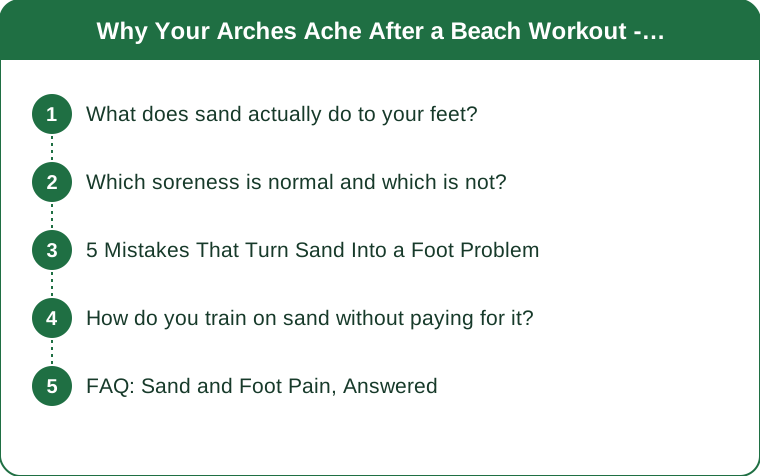
What does sand actually do to your feet?
It removes the stable base your foot normally pushes against. On pavement, force goes into the ground and comes straight back. On sand, part of every push-off is absorbed by the surface collapsing, so your foot works longer to produce the same movement.
Your foot has to grip and stabilize continuously. The intrinsic foot muscles - the small ones inside the foot itself - along with the arch structures, spend the entire session managing a surface that will not hold still. On a flat floor, they do far less.
Barefoot removes the arch support you did not know you were using. Most everyday shoes provide some degree of arch support and a stiff sole that limits how much your foot has to flex. Take both away, and the tissue supporting the arch takes the full range.
The waterline adds a slope you barely notice. Beaches are cambered, so running or walking along the firm wet strip means one foot is consistently higher than the other. That asymmetry loads the arches unevenly and is a well-known cause of one-sided complaints after beach sessions.
And soft dry sand is a different exercise from firm wet sand. Dry sand is the higher-effort, higher-instability version - excellent training, and also the version most likely to leave your feet aching if you have not built up to it.
Which soreness is normal and which is not?
Diffuse aching across the arch and the sole that eases as you move is typical. It behaves like ordinary muscle soreness: worst the morning after, better with gentle movement, largely gone in two to three days.
A specific pattern deserves more attention. Sharp pain under the heel with your first few steps out of bed, easing after a few minutes of walking and returning after periods of sitting, is the classic description of plantar fascia irritation. That is not the same as general foot fatigue and it responds badly to simply repeating the session.
Pain along the top of the foot that is tender to press on a specific spot is another one to take seriously rather than train through, particularly if you have increased barefoot activity quickly.
Any numbness, tingling, or pain that radiates is a reason to get looked at rather than to stretch harder.
Also account for what else the beach did. Sand sessions frequently produce sore calves and hamstrings at the same time, and tight calves increase the tension running through the arch. Sometimes the foot complaint is downstream of a calf issue.
This is general information, not medical advice. If first-step morning heel pain persists beyond a couple of weeks, or any pain is sharp, localized, or worsening, see a physiotherapist or podiatrist rather than working around it indefinitely.

5 Mistakes That Turn Sand Into a Foot Problem
Mistake 1: doing your full normal session on day one. Sand roughly changes the demand of every movement, and most people give their legs a warning but not their feet. A first sand session of fifteen to twenty minutes is plenty.
Mistake 2: going entirely barefoot from the start. Doing part of the session in shoes and part barefoot lets the feet build tolerance without absorbing the whole workout. Minimal or water shoes are a reasonable middle step.
Mistake 3: running the same direction along a cambered beach. Always running out and back with the water on the same side leaves you with a slope that never reverses. Turn around, or alternate.
Mistake 4: choosing deep dry sand for a long session. Deep sand is the most demanding version and it is best used in short bouts - intervals rather than a continuous forty minutes.
Mistake 5: skipping the wind-down because you are at the beach. Sand sessions end with a swim and a towel rather than the calf stretch and foot rolling you would do at the gym, and the feet notice the difference the next morning.
How do you train on sand without paying for it?
Build up in time, not intensity. Add roughly five to ten minutes per sand session rather than making the sessions harder. Your feet are the limiting tissue here, and they adapt slower than your cardiovascular system.
Use firm wet sand for continuous work and dry sand for intervals. Wet sand near the tideline is closer to a normal surface and far more forgiving for longer efforts. Save the deep stuff for short repeats where the difficulty is the point.
Strengthen the foot directly, off the beach. Short-foot exercises, toe spreads, calf raises with a slow lowering, and single-leg balance work all build the capacity the sand demands. A few minutes several times a week is enough to change how a beach session feels within a month.
Roll the sole afterwards. A ball or a chilled bottle under the arch for a minute or two per foot after a sand session is one of the highest-value two-minute habits available, and it addresses the tissue that just did the most work.
Stretch the calves properly, both versions. Straight-knee and bent-knee calf stretches target different structures, and calf tightness pulls directly on the tissue that runs under your arch.
And time it for the season you are actually in. Late August sand is still warm enough to make barefoot pleasant, and the cooler mornings coming in over the next few weeks are the ideal window for longer sand sessions - firm sand, mild temperatures, and fewer people to run around.
FAQ: Sand and Foot Pain, Answered
Why do my feet hurt after running on the beach?
Sand moves under every step, so the small muscles of your foot and the arch work continuously to stabilize it - and going barefoot removes the arch support and stiff sole your shoes normally provide. The beach camber adds an uneven load on top of that.
Is barefoot sand running good or bad for your feet?
It can be excellent foot training if the dose is right, and a reliable way to irritate your arch if it is not. Build up in time, use firm wet sand for longer efforts, and mix in some shod sessions early on.
How do I know if it is plantar fasciitis?
The classic pattern is sharp pain under the heel with your first steps in the morning that eases after a few minutes and returns after sitting. That is different from general foot fatigue and is worth having assessed rather than training through.
What should I do right after a sand workout?
Roll the sole of each foot for a minute or two, stretch the calves with both a straight and a bent knee, and rinse and dry between the toes. Two minutes of this prevents most of the next-morning complaints.
TL;DR:
- Sand collapses under every push-off, so your foot stabilizes continuously - and barefoot removes the support your shoes were providing.
- The beach camber loads one arch more than the other; turn around instead of always running with the water on one side.
- Build sand sessions up in time, use firm wet sand for continuous work and dry sand only for short intervals.
- Roll the sole and stretch both calf positions afterwards - it takes two minutes and prevents most next-day aching.
- Diffuse soreness that settles in a couple of days is adaptation; sharp first-step morning heel pain is not - get it assessed.
The last warm weeks are the best sand training of the year. Give your feet the same build-up you would give your legs.
See It in Motion
Seen here: Racerback Tank Top - White — shop similar styles on bubblelime.com
Keep Reading
This article is for general informational and styling purposes only. Fit, sizing, and product availability may vary.