The Beach Workout Mistake That Wrecks Your Knees on Sand
Quick Answer: Most sand-workout knee pain comes from letting the front knee cave inward or overextend past the toes on unstable sand footing — sand amplifies small form breaks that flat ground usually forgives.
Sand workouts get praised for being lower-impact, and that’s true for the joints in general, but the same instability that reduces impact also punishes sloppy knee tracking far more than a gym floor would.

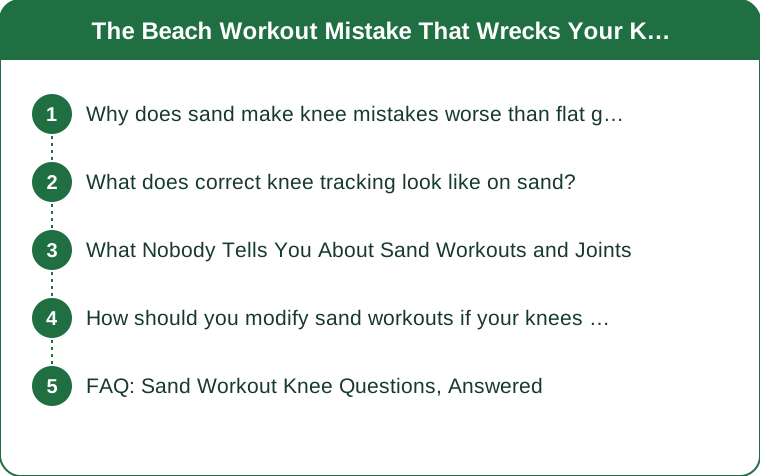
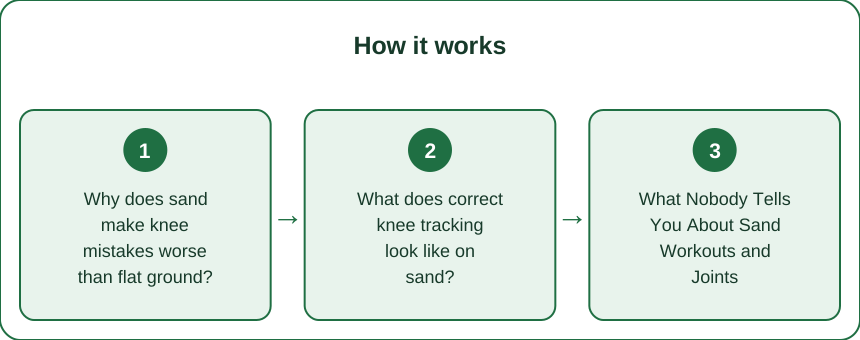
Why does sand make knee mistakes worse than flat ground?
Sand shifts slightly under every step, so any small inward knee cave gets amplified as your body tries to stabilize on an unpredictable surface. On flat ground your foot has a fixed reference point; on sand it doesn’t, which means poor knee tracking compounds with every rep instead of staying consistent.
What does correct knee tracking look like on sand?
Your knee should track directly over your second toe throughout a lunge or squat, not drift inward or outward as the sand shifts. Slowing your tempo on sand-based lower body moves gives you more time to actively correct knee position mid-rep, which matters more here than on stable ground.

What Nobody Tells You About Sand Workouts and Joints
Softer sand isn’t automatically safer sand. Very soft, deep sand requires more ankle and knee stabilization effort than firmer packed sand near the waterline, so beginners are often better off starting on firmer sand until their stabilizing muscles catch up, rather than assuming deeper sand is the gentler option.
How should you modify sand workouts if your knees are already sensitive?
Reduce lunge depth and favor bilateral moves (squats, glute bridges) over single-leg moves until sand-specific stability improves, since single-leg sand work asks the most of knee tracking. Warming up on firmer sand before moving to soft sand also gives your stabilizers a chance to activate gradually.
FAQ: Sand Workout Knee Questions, Answered
Is sand workout knee soreness always a form problem?
Not always — some extra soreness from the added stabilization demand is normal, but sharp or one-sided pain usually does point to a tracking issue.
Are shoes better than barefoot for sand workouts?
Barefoot is common and fine for most people, but supportive shoes are a reasonable choice if you have existing knee sensitivity and want more structure.
How long should a beginner do sand workouts before increasing intensity?
A few sessions on firmer sand, focused on form over intensity, is a reasonable base before progressing to deeper sand or added intensity.
TL;DR:
- Sand amplifies small knee-tracking mistakes that flat ground usually forgives
- Keep the knee tracking over the second toe, especially during lunges
- Softer, deeper sand demands more stabilization than firmer packed sand
- Start on firmer sand and favor bilateral moves if your knees are already sensitive
See It in Motion
Keep Reading
This article is for general informational and styling purposes only. Fit, sizing, and product availability may vary.