Sand or Boardwalk? What Actually Changes When You Move Your Workout to the Beach
Quick Answer: Sand training burns roughly 1.5x more energy than the same movement on a firm surface because of the unstable footing, but it also increases injury risk for ankles and calves if you’re not used to it — boardwalk is the safer choice for building a beach workout habit before progressing to sand.
Beach workouts sound simple until you actually try running on dry sand for the first time and your calves file a formal complaint by minute four.

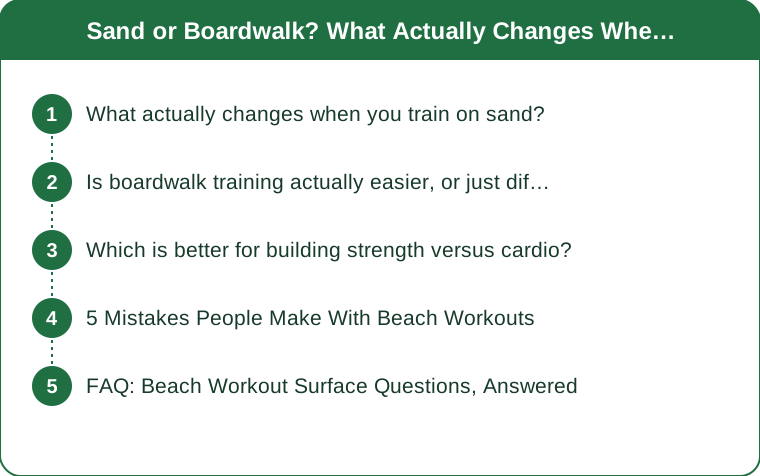
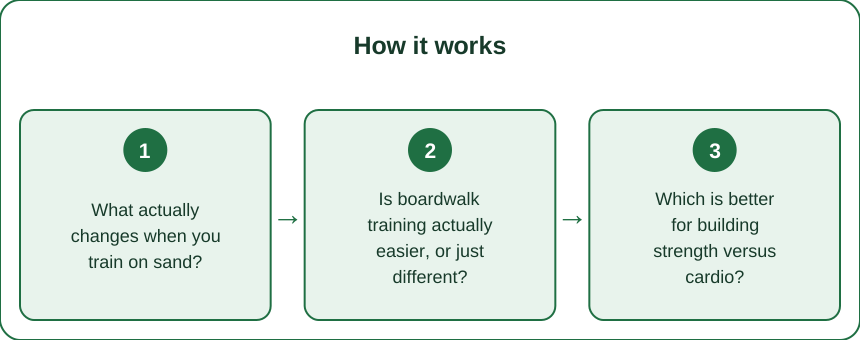
What actually changes when you train on sand?
Dry, loose sand collapses slightly under each step, which means your stabilizer muscles — ankles, calves, and hip stabilizers — work overtime to keep you balanced on every single stride. This is why 20 minutes on sand can feel as taxing as 35 on a firm surface.
Is boardwalk training actually easier, or just different?
Boardwalk gives you the firm, predictable surface of a treadmill with the added resistance of ocean wind and slight inclines near dune crossings. It’s genuinely lower-impact on ankles than sand, which makes it the better starting point if you’re newer to beach workouts.

Which is better for building strength versus cardio?
Sand is excellent for lower-body strength and stability work — bodyweight squats and lunges in wet, packed sand (not dry, loose sand) load the muscles more without the joint impact of hard pavement. Boardwalk favors steady-state cardio like walking intervals or light jogging where you want consistent pace.
5 Mistakes People Make With Beach Workouts
- Running in dry, loose sand right away instead of building up on wet packed sand first.
- Wearing regular running shoes on sand, which trap grit and blister feet — barefoot or minimal water shoes work better.
- Skipping a proper warm-up, since sand instability demands more from cold ankles.
- Training at midday sun without shade breaks or enough water.
- Ignoring wind direction, which can double effort on the return leg of an out-and-back route.
FAQ: Beach Workout Surface Questions, Answered
Which surface burns more calories, sand or boardwalk?
Sand burns more per minute due to instability, but boardwalk lets you sustain effort longer, so total calorie burn over a full session can end up similar.
Is sand training bad for your knees?
Actually the opposite for most people — the give in packed sand is gentler on knees than concrete, though ankles need to adapt gradually.
Can beginners start directly on dry sand?
It’s not recommended; start on wet packed sand or boardwalk for 2-3 weeks to build ankle stability first.
TL;DR:
- Sand training burns about 1.5x more energy per minute than firm ground due to instability
- Boardwalk is lower-impact and the better starting point for beach workout beginners
- Wet packed sand works for strength moves; dry loose sand is better saved for later
- Build ankle stability for 2-3 weeks before adding dry-sand running
Both surfaces earn a spot in a beach routine — the trick is sequencing them so your ankles catch up to your ambition.
See It in Motion
Seen here: High Waist 8” Yoga Shorts — shop similar styles on bubblelime.com
Keep Reading
This article is for general informational and styling purposes only. Fit, sizing, and product availability may vary.