The Last Beach Workouts of the Season: How to Use the Final Warm Weeks
Quick Answer: With a few weeks of usable beach weather left, prioritise the things sand does uniquely well - unstable-surface strength, low-impact running volume, and barefoot foot and ankle work - rather than repeating what you can do indoors all winter. Three sessions a week for the remaining warm weeks, with dry soft sand for strength and firm wet sand for anything involving running.
Most people spend their last beach sessions doing exactly what they would have done in a gym. It is a waste of a surface you will not have in six weeks.
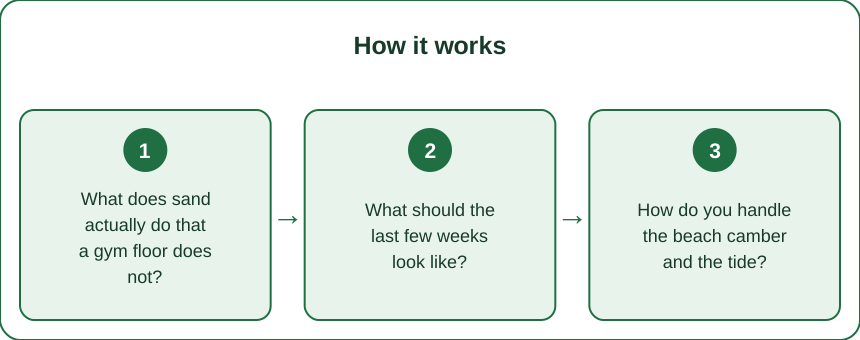
What does sand actually do that a gym floor does not?
It removes the elastic return, and it makes every landing a slightly different problem to solve.
No energy return. On a hard floor, a significant part of each stride and jump comes back to you elastically through the tendon. Sand absorbs it. The same session on sand costs meaningfully more energy at the same pace - estimates vary, but running on dry soft sand is substantially more demanding than on a firm surface.
Less impact, more work. The surface deforms under your foot, spreading the impact peak over a longer time. That is easier on joints while being harder on muscles - an unusual and useful combination, particularly if you have been managing knee irritation.
Constant micro-instability. Every footfall lands on a slightly different contour, so the small stabilisers in your foot, ankle, and hip work continuously. This is the part that genuinely does not transfer indoors, and it is the best reason to spend the last few sessions barefoot.
One real downside: sand changes your running mechanics, and soft dry sand in particular puts a lot of load through the calf and Achilles. If you have any Achilles history, keep running to firm wet sand and do strength work in the soft.
What should the last few weeks look like?
Three sessions a week, each using a different property of the surface.
Session A - Soft sand strength (about 35 minutes). Work in dry, deep sand where every rep is unstable.
- Walking lunges, 3 sets of 20 steps
- Squat jumps, 3 sets of 10 - the landing is the point, and sand makes it forgiving
- Single-leg deadlift, bodyweight, 3 sets of 8 each side
- Lateral bounds, 3 sets of 10 each way
- Bear crawl, 3 sets of 20 metres
- 60 to 90 seconds rest between sets
Session B - Firm sand intervals (about 30 minutes). On the wet, packed strip near the water at low tide.
- 10 minutes easy jog warm-up
- 8 x 45 seconds hard, 75 seconds walk
- 5 minutes easy
- Run out and back on the same line so any camber in the beach is balanced left and right
Session C - Barefoot foot and ankle (about 20 minutes). The one most people skip and the one that pays off through winter.
- Barefoot walk on varied sand, 10 minutes
- Heel raises in soft sand, 3 sets of 15
- Single-leg balance, eyes closed, 3 sets of 30 seconds each side
- Toe splay and short-foot drills, 2 sets of 10
Build in only if your feet are used to barefoot work; going straight to a full barefoot session after a summer in trainers is a reliable way to irritate an arch.

How do you handle the beach camber and the tide?
Every beach slopes toward the water, and running one direction along it means one leg is permanently running downhill.
The camber problem is real and underrated. Running 5km along a sloping beach in one direction loads your two legs asymmetrically for the whole session - different effective leg length, different hip and ankle angles. Over a few sessions this is a common cause of unexplained one-sided hip or IT band irritation.
The fixes:
- Run out and back on the same line, so each leg does both roles.
- Time your session near low tide, when the flat, firm strip is at its widest and flattest.
- For intervals, use the flattest section you can find even if it means a shorter loop.
Tide practicalities: check the tide table before you leave. The window around low tide gives firm, flat sand; high tide leaves only deep soft sand near the dunes, which is fine for strength but poor for running. Roughly two hours either side of low tide is the usable window on most beaches.
Late season specifics: the water is at its warmest of the year in late August and September even as the air cools, which makes a post-session swim more appealing than it was in June. Morning sand is cold to bare feet - a short warm-up walk before barefoot work matters more now than in midsummer.
5 Mistakes Everyone Makes in Sand Sessions
Mistake 1: Doing a normal run on soft dry sand. Dry sand is a strength surface, not a running surface. A 5km on it loads the calf and Achilles far beyond what most people are conditioned for, and the soreness shows up two days later.
Mistake 2: Going fully barefoot straight away. Summer-soft feet, hot sand, hidden shells, and unfamiliar loading. Start with 10 to 15 minutes barefoot and build. Scan the section you plan to use before you start - broken glass in sand is genuinely common on a public beach.
Mistake 3: Ignoring the camber. The third one is the one that surprises even regular runners: a one-directional beach run is an asymmetric training session, and the resulting hip or knee irritation is often blamed on the shoes.
Mistake 4: Underestimating the sun and the wind. A breeze off the sea masks how hot you are getting and how much you are sweating. Reflected light off water and pale sand raises exposure considerably. Water, hat, and sunscreen before, not after.
Mistake 5: Treating the last sessions as a farewell blowout. A single enormous end-of-season session on an unfamiliar surface is how people arrive at October carrying an injury. Keep the sessions ordinary and repeatable; the surface is already providing the novelty.
FAQ: End-of-Season Beach Training, Answered
Is running on sand better than running on roads?
Different, not better. Lower impact, higher muscular cost, and more ankle stability work - but with altered mechanics and camber issues. A mix is more useful than an exclusive diet of either.
How much harder is sand running?
Noticeably. On dry soft sand, expect to run considerably slower at the same effort. Judge by effort or heart rate, never by pace.
Should I wear shoes on the beach?
For running intervals, shoes on wet firm sand are the safer choice. For strength and balance work in dry sand, barefoot is the whole point.
Is cold water swimming after a workout useful?
It feels good and many people like the routine. Evidence on recovery is mixed, and very cold immersion straight after strength work may blunt some adaptations. As the sea cools into autumn, treat it as something you enjoy rather than a training tool.
What if my nearest beach is small or crowded?
Early morning and low tide solves most of it. A 30-metre strip is enough for lunges, bounds, crawls, and shuttle intervals - you do not need a long stretch to train on sand.
TL;DR:
- Use the last weeks for what sand alone gives you: instability, low impact, barefoot foot work
- Soft dry sand for strength, firm wet sand near low tide for anything that involves running
- Always run out and back on the same line to cancel the camber
- Build barefoot exposure gradually and check the ground before you start
- Three ordinary sessions a week beats one heroic farewell session
The beach stops being a training venue somewhere around the first properly cold morning, and the difference between now and then is only a few weeks. Spend them on the things you genuinely cannot replicate on a gym floor in January.
See It in Motion
Seen here: Racerback Tank Top - White — shop similar styles on bubblelime.com
Keep Reading
This article is for general informational and styling purposes only. Fit, sizing, and product availability may vary.