Late August Beach Workouts: The Heat Window Nobody Plans For
Quick Answer: Dry sand can run 20-30F hotter than the air and stays hot for hours after peak sun, so the friendly-looking 5pm beach in late August is often harsher underfoot than noon in June. Train before 9am or after 6pm, work on the damp packed sand near the waterline, and cut your usual session volume by about a third for the first few sessions of a heat wave.
The last two weeks of August are quietly the worst beach training window of the year. The air feels manageable, the crowds thin out, the light is beautiful - and the ground under you is still holding a full day of accumulated heat.
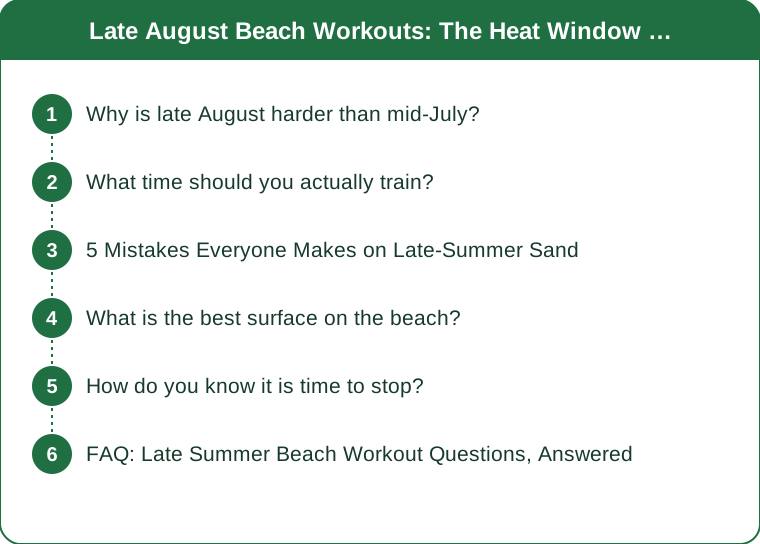
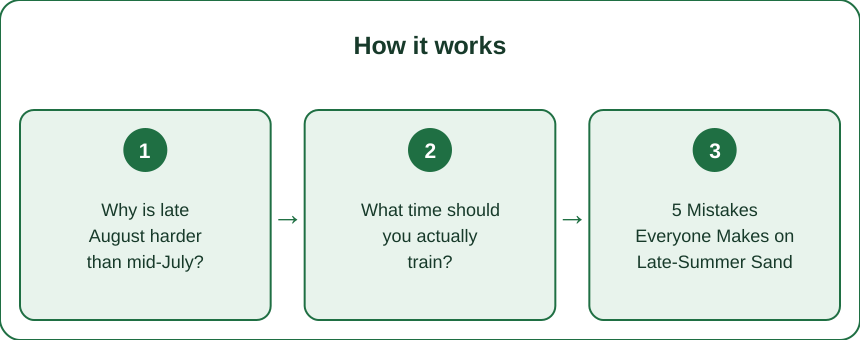
Why is late August harder than mid-July?
Two things stack.
First, the ocean and the sand are at their seasonal peak. Water temperature lags air temperature by roughly two months, which is why the sea is warmest in late August and coldest in late February. That warm water stops being the cooling resource it was in June - a dip that used to drop your core temperature now barely helps.
Second, dry sand is a heat trap. It absorbs solar radiation all day and releases it slowly. Surface temperatures on light dry sand in full sun regularly run 20-30F above air temperature. On a 88F day, that is sand hovering near 110F under your hands during a plank.
Add the fact that most people are less heat-acclimated in late August than they think - a summer of air conditioning does that - and you get sessions that feel disproportionately brutal for the number on the thermometer.
What time should you actually train?
Before 9am is the best window by a wide margin. Overnight radiative cooling has pulled the heat out of the sand, the air is at its daily minimum, and the UV index is still low.
After 6pm is the second window, but with a caveat: air temperature drops faster than sand temperature. At 6pm the air might feel pleasant while the dry sand is still holding late-afternoon heat. Test it with the back of your hand before you commit to any exercise that puts your palms down.
11am to 4pm is the window to skip in a heat wave, regardless of how nice the breeze feels. Sea breeze is genuinely deceptive - it evaporates your sweat fast enough that you feel cool and dry while your core temperature climbs and you lose more fluid than you notice.
A quick field test that works: press your palm flat on the sand where you plan to work and hold for 5 seconds. If you want to lift it before five, move to the damp packed sand or come back later.
5 Mistakes Everyone Makes on Late-Summer Sand
1. Training on dry sand for the sake of difficulty. Dry sand is unstable, hot, and exhausting - a fine tool, but it triples the ankle and calf load of every movement. If you have not been on it all summer, start on the damp packed strip.
2. Doing hand-down work at midday. Planks, burpees, mountain climbers, push-ups. Your palms take the surface heat directly, and hot sand is the reason people cut sessions short far more often than fatigue is.
3. Drinking only when thirsty. In sea breeze, sweat evaporates before you feel wet, so thirst arrives late. Aim for roughly 16-20 oz in the hour before and a few sips every 15 minutes during.
4. Ignoring reflected UV. Sand reflects a meaningful share of UV back up at you, which is why people burn under their chin and on the underside of their arms at the beach and nowhere else. Reapply after any water contact.
5. Keeping the same volume as your indoor sessions. Working in heat raises heart rate substantially at identical effort. Same workout, different physiology - cut about a third of the volume for the first several hot sessions and add it back as you acclimate over 10-14 days.
What is the best surface on the beach?
The beach has three distinct training surfaces, and they are not interchangeable.
Damp packed sand near the waterline is the workhorse. It is cooler because water conducts heat away, it is firm enough for stable landings, and it still gives just enough to be gentler on joints than pavement. Do your running, lateral work, and anything with hands down here.
Dry soft sand is a strength and conditioning tool, not a default. It is superb for short hill-style efforts, sled-like sprints, and single-leg stability work, and it will make your calves and feet sore in a way you did not order. Use it in short doses - 20-30 second efforts, not 20-minute sessions.
Wet sand in the tidal wash shifts under you unpredictably and is the least appropriate for anything requiring stability. Skip it for lunges, jumps, and single-leg work.
Check the tide chart before you go. At high tide, the packed-sand strip on many beaches disappears entirely, and you are left choosing between soft sand and the surf line.
How do you know it is time to stop?
Heat illness announces itself before it becomes dangerous, but the early signs are easy to talk yourself out of.
Slow down or stop and get to shade if you notice: an unusually high heart rate at an easy effort, goosebumps or chills in the heat, a headache building behind the eyes, or feeling suddenly clumsy on the sand.
Stop immediately and get help for confusion, disorientation, fainting, or hot dry skin with no sweat. Those are heat-stroke-range signs and they are an emergency, not a rest-in-the-shade situation.
Bring more water than you think you need, a hat, and a light long-sleeve layer for the walk back - and if you train alone, tell someone your window. This is general information, not medical advice. If you have a heart condition, are pregnant, or take medication that affects fluid balance or heat tolerance, ask your doctor before training in high heat.
FAQ: Late Summer Beach Workout Questions, Answered
Is it cooler to work out right by the water?
Yes, meaningfully. The damp sand is cooler underfoot, the breeze is stronger, and the air just above the waterline runs a few degrees lower. It is the single easiest change you can make.
Should I swim before or after the workout?
After, in late summer. Warm late-August water does less cooling than you expect, and swimming first leaves you working with salt-dried skin and an already-elevated heart rate. Use it as a cooldown.
How long does it take to get used to training in heat?
Most of the adaptation - more efficient sweating, better plasma volume, lower heart rate at the same effort - lands within 10-14 days of regular exposure. It also fades within about a week off, which is exactly why late August catches so many people out.
TL;DR:
- Dry sand runs 20-30F above air temperature and stays hot well past peak sun.
- Train before 9am or after 6pm, and use the 5-second palm test before any hands-down work.
- Damp packed sand near the waterline is the default surface; soft dry sand is a short-dose tool.
- Cut volume by a third during a heat wave and rebuild over 10-14 days of acclimation.
Late August is the best-looking and worst-behaving beach month of the year. Move your session to the edges of the day, stay near the water, and the last weeks of summer become the best training of the season instead of the sweatiest.
See It in Motion
Seen here: High Waist Yoga Leggings with Side Pockets — shop it on bubblelime.com
Keep Reading
This article is for general informational and styling purposes only. Fit, sizing, and product availability may vary.