The Post-Labor-Day Beach Is the Best Training Ground You'll Get All Year
Quick Answer: Early September through late October is the best beach training window in the northern US: the water is still holding summer heat while the air has dropped 10-15 degrees, the crowds are gone, parking is free, and you can train at midday without the heat risk that made July sessions miserable. The main adjustments are layering for the wind, watching for cooler water on longer swims, and knowing that lifeguard coverage typically ends after the holiday weekend.
Everyone abandons the beach the week after Labor Day. The conditions are about to get considerably better than they were all summer.
Why does the beach get better right when everyone leaves?
Because water and air change temperature at completely different rates.
Water has an enormous heat capacity, so the ocean lags the air by roughly six to eight weeks. Peak ocean temperature on most of the US Atlantic coast arrives in late August and September - after peak air temperature. Meanwhile air temperature drops noticeably through September.
That mismatch produces the best conditions of the year:
- Air in the 60s and low 70s instead of the high 80s - which is a substantially better training temperature for anything sustained.
- Water still in the high 60s to low 70s on many stretches of coast well into September - warm enough for swimming without the shock.
- Lower humidity, which is the variable that actually determines whether you can cool yourself efficiently.
- Softer, more angled light in the morning and late afternoon, which means less UV load for the same session length.
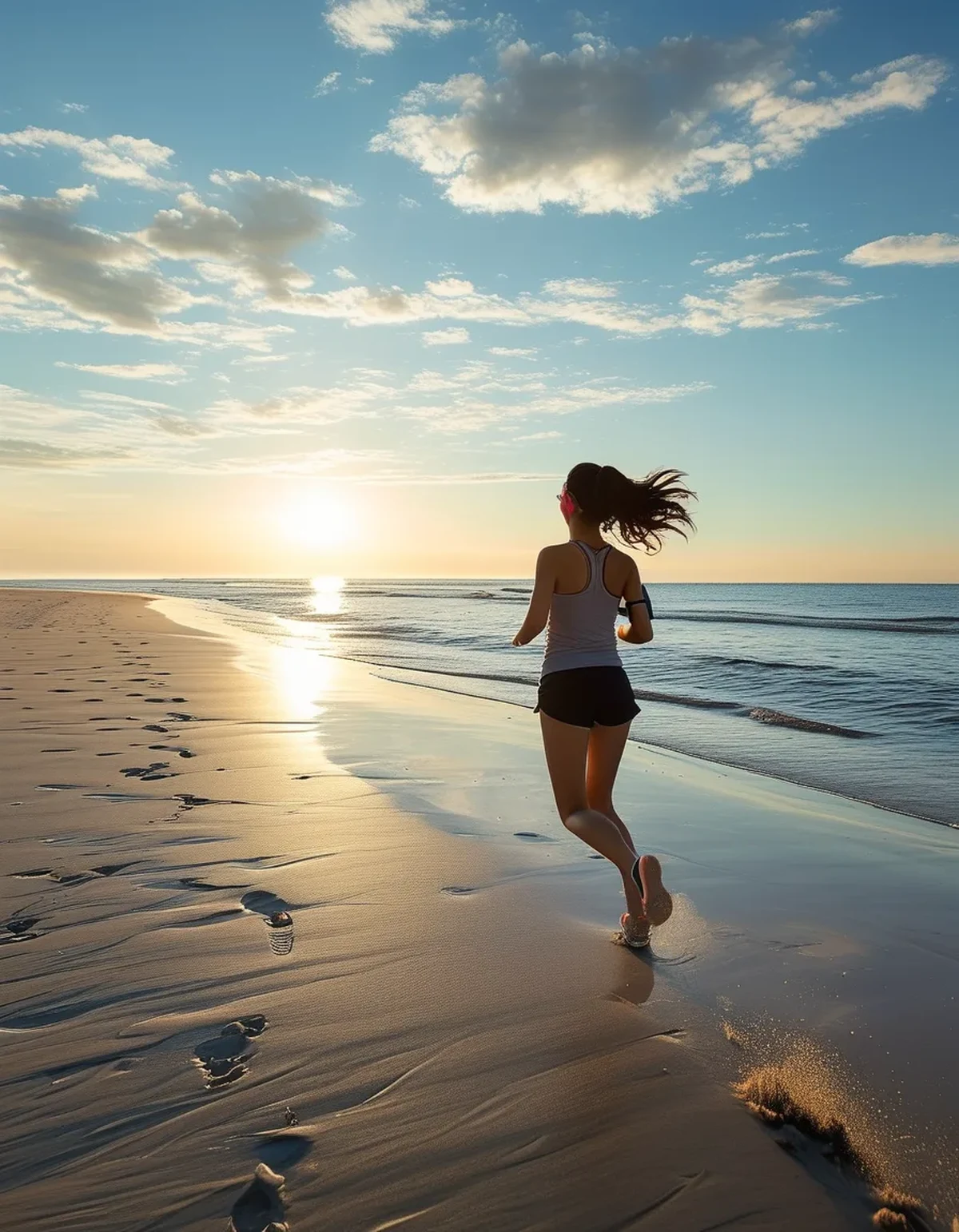
And the sand is empty. No umbrellas to run around, no towels to dodge, no need to arrive at 6am to find parking. A stretch of beach you couldn’t get near in July becomes a private training ground with a 200-metre straight run and nobody watching you do burpees.
What can you actually train that you can’t elsewhere?
Sand offers a specific set of things a gym floor genuinely can’t replicate.
Unstable-surface strength work. Every step on soft sand requires stabilising muscles in the foot, ankle, and hip that a firm floor never asks for. Single-leg work, lunges, and lateral movement on sand produce a different demand from the same movement indoors.
Reduced-impact running with increased effort. Sand absorbs impact forces that a road transmits straight up your leg, while simultaneously making the same pace considerably harder. That combination - lower impact, higher metabolic cost - is unusual and useful, particularly for anyone managing a joint that dislikes pavement.
Genuine sprint work. Soft sand caps your top speed, which means you can do repeated near-maximal efforts with less strain risk than sprinting flat out on a track.
Barefoot foot conditioning. Sand is the most forgiving surface for building foot and ankle strength barefoot, and it’s the reason a lot of foot-strengthening protocols mention it specifically.
Open-water swimming with no crowds. Late-season water is warm, the beach is quiet, and the swimming is better than it was in August when the water was full of people.
What to be honest about: sand running changes your gait, loads the calves and Achilles heavily, and is a poor choice if you’re returning from an Achilles or calf injury without building up gradually.
5 Mistakes People Make in the Autumn Beach Window
Mistake 1: Dressing for the water instead of the wind. The air is fine until you stop moving and a coastal wind hits wet skin. Sea breezes are stronger in autumn, and the difference between comfortable and genuinely cold is one gust. Bring a windproof layer and a dry top for after - not for the workout, for the ten minutes after it.
Mistake 2: Assuming lifeguards are still there. On most US beaches, guarded hours end after Labor Day weekend. This is the single most important safety change of the season and it’s invisible - the beach looks identical. Swim with someone, stay within your depth, and check local conditions before going in.
Mistake 3: Skipping sunscreen because it’s cooler. UV doesn’t track air temperature. September UV index at midday on an open beach with sand reflection remains high, and the cooler air removes the discomfort that normally reminds you.
Mistake 4: Doing your July volume on the first cool day. Cooler air makes hard efforts feel easier, so people overshoot. Your calves and Achilles don’t care that the weather improved - sand volume should still build gradually.
Mistake 5: Forgetting to hydrate because you’re not obviously sweating. Cool air and wind evaporate sweat before you notice it. Fluid loss in autumn coastal conditions is easy to underestimate, and the thirst signal arrives late.

What does a good autumn beach session actually look like?
Three templates, all 35-50 minutes, all doable with nothing but a towel.
Template 1 - Sand intervals (the highest-value session). 10 minutes easy jogging on wet packed sand near the water to warm up. Then 8 x 30 seconds hard on soft dry sand, 90 seconds walking recovery. Finish with 10 minutes easy. The wet-sand warm-up matters: going straight into soft sand cold is how calves get strained.
Template 2 - Strength circuit. 4 rounds of: 20 walking lunges, 15 push-ups, 20 lateral bounds, 30-second plank, 10 single-leg glute bridges per side. Rest 90 seconds between rounds. On soft sand this is considerably harder than the same circuit indoors, so start with 3 rounds.
Template 3 - Swim and carry. 15-20 minutes of swimming parallel to shore within your depth, then 10 minutes of loaded carries along the sand using whatever you brought - a full water container works. Finish with a barefoot walk on wet sand.
Session structure notes: wet packed sand near the waterline is firmer and faster; soft dry sand is dramatically harder. Alternating between them within a session is the easiest way to control intensity without a watch. And run out-and-back rather than one direction only - beaches slope, and running with the same foot always downhill for 20 minutes is a reliable way to irritate a hip.
Best time of day: midday, which is the one thing that reverses completely from summer. The heat risk is gone, the light is good, and the beach is at its emptiest.
How far into the season can you keep going?
Further than most people think, with the right adjustments at each stage.
Early September: essentially peak conditions. Water warm, air mild, everything works. No adjustment needed beyond sunscreen and knowing the lifeguards have gone.
Late September to mid-October: the sweet spot for land training. Air in the 50s and 60s, and running and circuit work feel excellent. Water is cooling noticeably - shorter swims, and a wetsuit top starts being worth considering for anything over 15 minutes.
Late October to November: land training only for most people. Add a windproof layer, gloves for the early sessions, and shift toward the middle of the day. The wind, not the temperature, is what ends the season - a calm 45-degree day on the sand is pleasant, and a windy 55-degree one is not.
Through winter: it’s genuinely viable if you dress for it, and a winter beach is an extraordinary place to train. Firm wet sand near the waterline, a proper windproof shell, and shorter sessions.
The practical planning point: the two months after Labor Day are the highest-quality window of the year, and they’re short. If beach training is something you keep meaning to do, this is the period to actually put in the calendar - not next June, when the parking is impossible and the sand is full and the air is 88 degrees.
FAQ: Autumn Beach Training, Answered
Is the water safe to swim in without lifeguards?
It requires more caution rather than being categorically unsafe. Swim with someone, stay within your depth, check local surf and rip current forecasts, and swim parallel to shore rather than out. Autumn also brings stronger swells on many coasts.
Should I run on wet or dry sand?
Wet packed sand is easier and closer to road running; dry soft sand is far harder and more demanding on calves. Warm up on wet, do hard efforts on dry, and build the dry-sand volume gradually.
Do I still need sunscreen in October?
Yes for midday sessions - UV is lower than summer but far from negligible, and open sand and water both reflect it. Cooler air removes the sensation that normally prompts you.
How cold is too cold for the water?
That depends on your acclimatisation and how long you’re in. Cold water carries real risks - shortened breath-hold and impaired coordination - so shorten swims as temperatures drop, never swim alone in cold water, and get warm quickly afterward.
TL;DR:
- Ocean temperature lags air by 6-8 weeks, so September gives warm water with cool air
- Empty sand, free parking, and midday training that was impossible in July
- Lifeguard coverage typically ends after Labor Day - the beach looks the same and isn’t
- Warm up on wet packed sand before any hard effort on soft dry sand
- The wind, not the temperature, is what eventually ends the season
The best two months of beach training start the week everyone stops going.
See It in Motion
Seen here: High Waist Jogger Sweatpants with Pockets — shop it on bubblelime.com
Keep Reading
This article is for general informational and styling purposes only. Fit, sizing, and product availability may vary.