The Last Warm Weekend: A Beach Workout Plan for the End of the Season
Quick Answer: Late-season sand is firmer near the waterline, the beach is emptier, and the air is 10-15 degrees cooler than midsummer - which means you can train harder and longer than you could in July. Use the wet strip for running and the dry sand for strength and intervals, keep the first session to 20-25 minutes because sand doubles your calf and Achilles load, and go barefoot only on the wet strip.
There are maybe four or five usable weekends left in the northern US season. This is the plan for using them rather than mourning them.
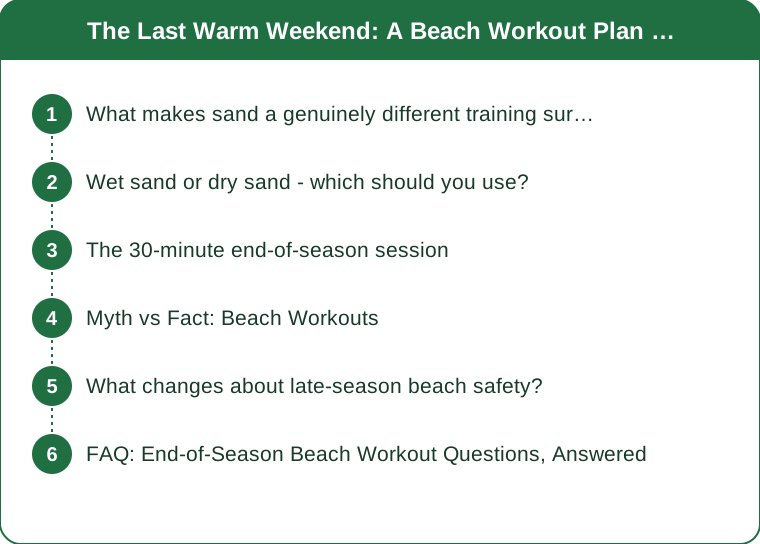
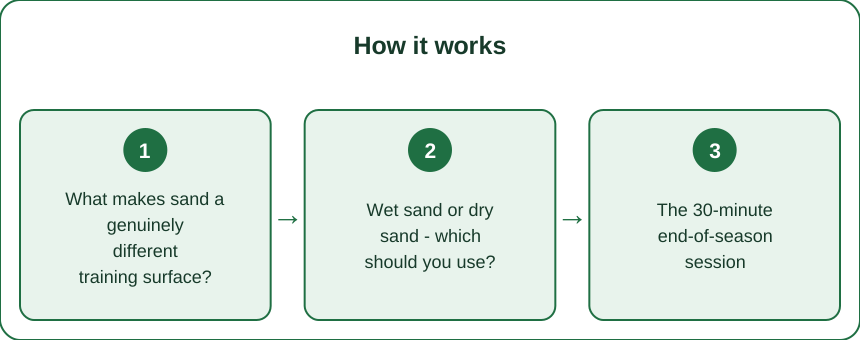
What makes sand a genuinely different training surface?
It removes the energy return you get from every other surface.
When you push off pavement, the ground gives some of that energy back. When you push off dry sand, it collapses under you and the energy is gone. Research on sand running consistently shows a substantially higher energy cost than running the same speed on a firm surface - it is one of the largest surface effects in exercise science.
Four things change at once:
- Higher metabolic cost at every speed. You will be noticeably more out of breath at a pace that feels slow
- Much less impact. Sand absorbs the landing forces that would otherwise go through your knees, which is why it is often recommended for people managing joint discomfort
- Far more calf, Achilles, and foot work. The instability and the deeper ankle range load these hard. This is the part people underestimate
- Constant micro-adjustments. Every step lands slightly differently, which trains ankle stability in a way a treadmill never will
The trade-off in one line: easier on the joints, much harder on the calves and the lungs.
Why late season is better than peak season: cooler air means you can sustain effort instead of overheating in ten minutes, the sand holds moisture longer and firms up, and there is actually room to run in a straight line.
Wet sand or dry sand - which should you use?
Both, for different jobs. Choosing wrong is the most common mistake.
The wet strip near the waterline is firm, level, and closest to a normal running surface. Use it for anything continuous - running, walking intervals, longer efforts. It is also the only place you should be barefoot, because the surface is smooth and predictable.
Dry sand is soft, unstable, and brutal. Use it for short efforts - sprints of 15-25 seconds, strength circuits, jumps, and anything where the difficulty is the point. Ten minutes in dry sand is a serious session.
The camber problem nobody mentions: most beaches slope toward the water, so running along the wet strip means one leg is always landing lower than the other. Over 30 minutes that asymmetry is real and it is a genuine cause of hip and IT band irritation. Turn around at the halfway point so each leg spends equal time on the low side.
Barefoot rules:
- Wet strip barefoot is fine once you have adapted, and excellent for foot strength
- Dry sand barefoot for sprints is a good way to strain a calf on session one
- Cap your first barefoot beach session at 15 minutes, regardless of how good it feels. The soreness arrives the next day
- Scan the sand before you sprint. Late season means glass, shells, and buried debris after a busy summer
The 30-minute end-of-season session
Built to fit between arriving and the light going, which in late August is earlier than you think.
Warm-up - 6 minutes, on the wet strip:
- 3 minutes easy walking, gradually faster
- 10 walking lunges each side
- 10 leg swings each direction, each leg
- 20 seconds of calf raises, slow. Do not skip these - the calves are about to do a lot
Block 1 - sand intervals, 10 minutes, dry sand:
- 20 seconds hard effort, 40 seconds walking recovery
- 10 rounds
- The effort should be about an 8 out of 10, not a full sprint. Dry sand punishes full sprints on day one
Block 2 - strength circuit, 10 minutes, dry sand:
- 12 squat jumps
- 10 push-ups, hands in the sand - much harder than it sounds because the surface gives
- 20 walking lunges total
- 30-second plank
- Rest 60 seconds, repeat 3 times
Cool-down - 4 minutes, wet strip: easy walk, then calf and hip flexor stretches, 30 seconds each.
Session one should be half this. Do the warm-up, five interval rounds, one circuit, and go home. Sand soreness peaks at about 36 hours and it surprises people who are otherwise fit.

Myth vs Fact: Beach Workouts
Myth: Running on sand is always better for your knees. Fact: Impact forces are genuinely lower, which helps knees. But the load transfers to the calves, Achilles, and plantar fascia, so you are moving the risk rather than removing it. It is a good option for knee discomfort and a bad idea if you have an irritated Achilles.
Myth: You should always train barefoot on the beach. Fact: On the firm wet strip, barefoot is great and builds foot strength. In dry sand, and especially for anything explosive on session one, shoes are the sensible choice.
Myth: Late-season water is too cold to be useful. Fact: Sea temperature in the northern US typically peaks in late August and early September, well after air temperature does. The water is often warmer now than it was in June.
Myth: Sand workouts are just cardio. Fact: The instability makes them a genuine stability and calf-strength stimulus. Lunges and single-leg work in sand are considerably harder than the same work on a floor.
Myth: You do not need as much water because it is cooler. Fact: Cooler air masks how much you are sweating, and sea breeze evaporates it before you notice. Dehydration is arguably more likely in September than in July because you stop paying attention to it.
What changes about late-season beach safety?
Four things, and three of them catch people out precisely because the beach feels calmer.
Fewer lifeguards, and shorter hours. Most US beaches reduce or end lifeguard coverage after Labor Day, and many reduce hours before that. If your session involves any swimming, check the schedule and assume you are on your own.
Rip currents do not care about the season. Late-summer and early-autumn storm systems offshore can produce strong currents on a day that looks perfectly calm. Check the local surf forecast. If you are caught, swim parallel to the shore rather than against the pull.
Light goes earlier and faster. In the northern US, sunset moves roughly 15 minutes earlier every two weeks through this period. A 6pm session that finished in daylight in July finishes in dusk by the end of August, and a dark beach with debris underfoot is not a place to be sprinting barefoot.
Sun exposure is still real. UV is lower than midsummer but far from negligible, and the cooler air removes the sensation that usually prompts you to reapply sunscreen. Water and sand both reflect UV upward, which is why people burn under their chin at the beach.
One practical addition: bring a towel or mat for the floor work. Wet sand in your palms during push-ups is fine. Sand in a fresh graze is not, and abrasions from sand are more common than people expect.
If you are managing an Achilles or plantar fascia issue, sand is one of the surfaces most likely to aggravate it - check with a physiotherapist before making it a regular thing. This is general information, not medical advice.
FAQ: End-of-Season Beach Workout Questions, Answered
How much harder is running on sand?
Substantially - studies comparing sand to firm surfaces find a large increase in energy cost, particularly in soft dry sand. Expect your usual pace to feel one to two levels harder.
Why are my calves so sore the next day?
Because sand deepens ankle range and removes energy return, so the calf does far more work per step. It is the most predictable outcome of a first sand session and it settles within two or three sessions.
Is it worth going if the beach is crowded?
Early morning is nearly always empty in late season, and the sand is firmest before the sun dries it out. It is genuinely the best hour of the day for this.
What should I bring?
Water, a towel, sunscreen, shoes even if you plan to go barefoot, and a phone in a bag. That is the whole list.
TL;DR:
- Late-season sand is firmer, cooler, and emptier - the best conditions of the year
- Wet strip for continuous running, dry sand for short intervals and strength
- Sand doubles the calf and Achilles work, so cap session one at 20-25 minutes
- Turn around at halfway to cancel out the beach camber
- Check lifeguard hours and sunset times; both change fast after August
There are only a handful of weekends left where this is comfortable. Go early, keep the first one short, and let the calves catch up before you get ambitious.
See It in Motion
Seen here: High Waist Embossed Yoga Leggings with Side Pockets — shop it on bubblelime.com
Keep Reading
This article is for general informational and styling purposes only. Fit, sizing, and product availability may vary.