Why Beach Workouts Leave You Sorer Than the Same Routine on Pavement
Quick Answer: Sand workouts cause more soreness than the same routine on pavement because the unstable surface forces small stabilizer muscles to fire on every single rep, and those muscles fatigue and micro-tear faster than your prime movers do.
You did the exact same lunge-and-squat circuit you always do, just on sand instead of the gym floor — and two days later you’re walking like you ran a marathon. That’s not bad luck. That’s sand doing exactly what it’s supposed to do.

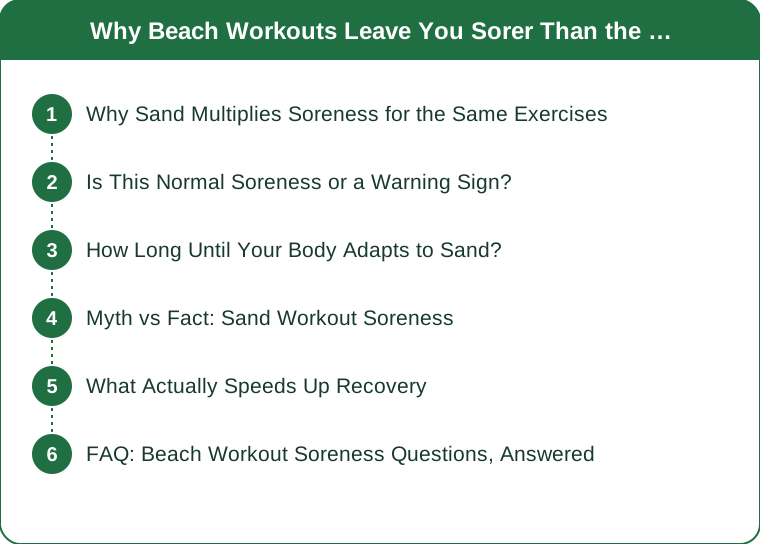
Why Sand Multiplies Soreness for the Same Exercises
On a stable surface, your prime movers (glutes, quads, hamstrings) do almost all the work while stabilizer muscles stay relatively quiet. On sand, every rep requires constant micro-adjustments from your ankles, feet, and hip stabilizers just to keep you upright, meaning muscles that normally coast are suddenly working overtime. Those smaller, less-conditioned stabilizer muscles are the ones that end up sorest, not the big muscles you were expecting.
Is This Normal Soreness or a Warning Sign?
Diffuse soreness across the ankles, feet, and outer hips that peaks 24-48 hours later and fades within 3-4 days is a completely normal delayed-onset muscle soreness (DOMS) response. Sharp, localized pain on one side, pain that worsens instead of improving, or any swelling around a joint is different and worth resting from sand training until it resolves.
How Long Until Your Body Adapts to Sand?
Most people notice meaningfully less soreness after their third or fourth sand session, as stabilizer muscles adapt the same way any muscle adapts to new stimulus — not through ‘toughening up’ but through genuine strength gains in muscles that were previously undertrained. Expect the adaptation curve to take about 2-3 weeks of once- or twice-weekly sessions.

Myth vs Fact: Sand Workout Soreness
Myth: More soreness means a better workout. Fact: Soreness reflects how unaccustomed a muscle is to the stress, not how effective the training was — a well-conditioned sand athlete can do a hard session with minimal soreness while still building fitness. Myth: You should push through ankle pain because ‘it’s just sand.’ Fact: Sand’s instability makes it easier to roll an ankle without noticing until later; sharp ankle pain deserves the same caution on sand as anywhere else.
What Actually Speeds Up Recovery
Gentle ankle circles and calf stretching the evening of a sand workout target the exact muscles that took the unusual load. A short barefoot walk on grass or a stable surface the next day keeps blood flow moving without adding more instability stress. Skip icing unless there’s actual swelling — for normal DOMS, gentle movement outperforms ice.
FAQ: Beach Workout Soreness Questions, Answered
Should I stop doing beach workouts if I’m always sore afterward?
No — persistent-but-fading soreness after each session is the normal adaptation process; only stop if pain is sharp, localized, or lasts more than 4-5 days.
Does wearing shoes on sand reduce the soreness?
Slightly, since shoes add a small amount of stability, but they also reduce the stabilizer-strengthening benefit that makes sand training valuable in the first place.
Is it better to start sand workouts at low tide or high tide?
Low tide, packed-wet sand is more stable and a gentler entry point for your first few sessions; move to dry, loose sand once your ankles and feet have adapted.
TL;DR:
- Sand soreness comes from stabilizer muscles, not your prime movers
- Diffuse, fading soreness over 2-4 days is normal DOMS, not a red flag
- Expect noticeably less soreness after 3-4 sessions as stabilizers adapt
- Gentle movement the next day beats ice for standard sand-workout soreness
The soreness isn’t a sign you did something wrong — it’s proof your body is building stabilizer strength that flat-ground workouts never touch.
See It in Motion
Seen here: High Waist Yoga Leggings with Inner Pocket — shop it on bubblelime.com
Keep Reading
This article is for general informational and styling purposes only. Fit, sizing, and product availability may vary.