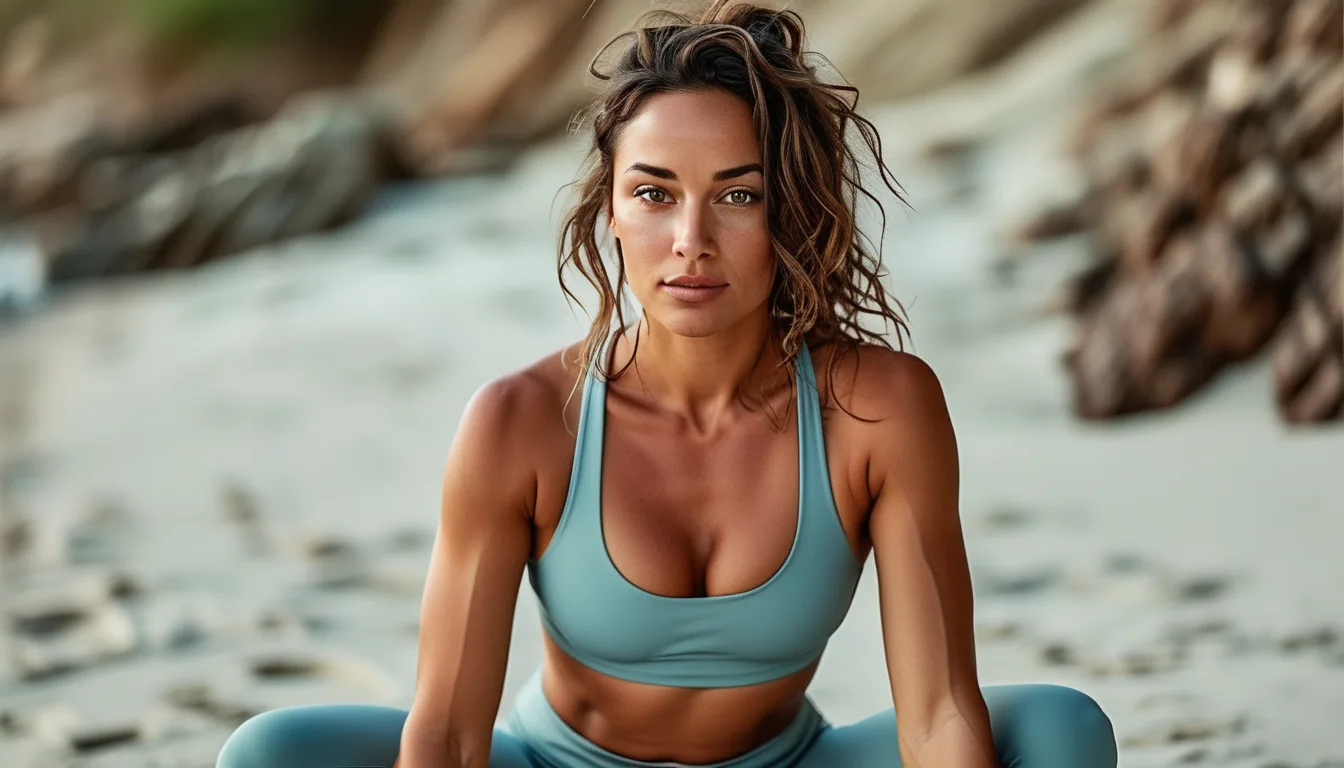
The Towel-Sized Workout for a Beach With No Empty Sand
Quick Answer: You can get a legitimate full-body session inside one towel’s footprint: squat and hinge patterns, push-up variations, plank series, and glute work all fit in six feet of sand. Structure it as five 5-minute blocks, go early or late to dodge peak heat and crowds, and use the sand’s instability as the resistance instead of range or sprint distance.
Every beach workout article assumes an empty dawn beach with forty meters of runway. In August, on any beach worth visiting, you get a towel-sized plot between a family of five and someone asleep. The good news: a towel is enough, if you program for depth instead of distance.

Why does a small-footprint workout actually work?
Because sand changes the exercise math. On firm ground, bodyweight training needs space or load to get hard - jumps, sprints, weights. On dry sand, the surface itself is the load. Every squat, lunge, and push-up starts from an unstable base, so your stabilizers work overtime, and the surface steals the elastic rebound you normally get for free. Research on sand training consistently shows higher energy cost for the same movement, with the bonus of gentler landings.
Instability plus no rebound means static and slow beats big and bouncy. A slow three-second-descent squat on sand, feet fighting for level, is a genuinely different exercise from the same squat on your kitchen floor. Pauses, tempo, and single-leg variations - the exact tools that need zero space - are the ones sand amplifies most.
There is also an underrated psychological benefit: a defined footprint removes the self-consciousness that stops many people from training on a busy beach at all. You are not performing a bootcamp for the crowd. You are a person doing some exercises on a towel, which is unremarkable - and that is exactly the point.
What does the 30-minute towel session look like?
Five blocks, five minutes each, minimal transitions. Work 40 seconds, rest 20, within each block.
Block 1 - wake-up: slow squats with a 3-count descent, alternating reverse lunges, standing hip hinges reaching toward the sand. The sand does the balance coaching.
Block 2 - push: hands-on-towel push-ups - the towel keeps wrists level - then pike push-ups, then a push-up hold at half depth. Knees down is fully legitimate on a surface this unstable.
Block 3 - legs for real: single-leg glute bridges on the towel, then split squats with the back foot on sand, slow tempo. The back foot sinking is the feature.
Block 4 - core: forearm plank with slow shoulder taps, side plank each side, dead bug on the towel. Sand under the forearms turns a plank into a fight worth having.
Block 5 - finisher: squat-to-calf-raise flow, standing knee drives, and one 60-second wall-less sit against nothing - a static squat hold - to end honest.
Total footprint: your towel plus one step in any direction. Total equipment: none, though a second towel for hands and face upgrades the whole experience.

When should you time it around heat and crowds?
Mid-August beach days have a predictable rhythm, and the workout should ride it.
The early window - before about 9am - is the best all-around slot. Cooler air, cool sand underfoot, wide towel spacing, and UV still building. The sand near the waterline is also firmer in the morning after the overnight tide, which gives you a slightly more stable stage if you want it.
The late window - after about 5pm - is the social one. Heat breaks, crowds thin as families pack up, and a session followed by a swim in the warmest water of the day is a genuinely elite way to end an August Saturday.
The middle of the day is the one to refuse. Peak UV, scorching dry sand - hot enough to change how you place your hands and feet, which quietly ruins form - and peak crowding. If midday is your only option, claim the damp firm strip near the water, halve the session, and keep your hands off the sand entirely: standing blocks only.
Whichever window you pick, the sunscreen went on 20 minutes before you started, the water bottle is frozen half-full from home, and your phone lives wrapped in the towel corner - sand finds everything.
5 Mistakes Everyone Makes Training on a Crowded Beach
1. Claiming more territory than the beach can spare. Walking lunges through other people’s towel zone is how beach workouts get their bad reputation. Program vertically - tempo, pauses, single-leg - not horizontally.
2. Kicking sand. Every explosive move on dry sand sprays it, and the wind decides where it lands. Check wind direction once before your finisher, and take anything ballistic to the empty side of your plot.
3. Training barefoot on hot sand and calling the hopping a warm-up. By late morning, dry sand can be painfully hot. Test with your hand first; the damp strip or a pair of old trainers solves it.
4. Going straight to sprint-brain. People associate beaches with sprints, attempt them in a crowd on day one, and pull something in front of an audience. Sprints need empty sand and a calf-friendly build-up. The towel session needs neither.
5. Skipping the rinse. Salt and sand inside waistbands and sports bras for the drive home is how beach workouts become chafing incidents. Ocean dip, freshwater rinse if the beach has a shower, dry towel. In that order, every time.
FAQ: Small-Space Beach Workout Questions, Answered
Is a towel-sized beach workout actually effective?
Yes - dry sand raises the cost of every movement and the instability loads your stabilizers, so slow bodyweight work gets surprisingly hard. It will not replace heavy lifting, but as a summer conditioning session it is legitimate.
Should I work out on the towel or directly on sand?
Hands and forearms on the towel, feet mostly on sand. The towel keeps your base level for planks and push-ups; the sand provides the challenge for everything standing.
What do I do about sweat and sunscreen?
Apply sunscreen 20 minutes before, choose a sweat-resistant formula, and re-apply after you swim. Bring a second dry towel for your face - sunscreen in your eyes mid-plank ends sessions.
Can I do this workout pregnant or as a beginner?
The structure scales - fewer blocks, knees-down variations, longer rests, full shade. If you are pregnant or managing a condition, clear the plan with your provider first. This is general information, not medical advice.
TL;DR:
- A towel footprint is enough: sand instability plus slow tempo replaces space and equipment.
- Five 5-minute blocks - wake-up, push, legs, core, finisher - make a complete 30-minute session.
- Train before 9am or after 5pm; refuse peak-heat midday sand.
- Respect the crowd: no traveling moves, no sand spray, rinse before the drive home.
The crowded-beach workout is a constraint problem, and constraints make better sessions than empty fields do. Claim your six feet, go slow on purpose, and swim after - August is nearly over and the ocean is at its warmest.
See It in Motion
Seen here: High Waist Yoga Leggings with Side Pockets — shop it on bubblelime.com
Keep Reading
This article is for general informational and styling purposes only. Fit, sizing, and product availability may vary.